
(As told by Dadi Sarala, while the afternoon sun streamed through the courtyard, warming the freshly washed clothes drying on the line)
“Come closer, my little fireflies,” Dadi Sarala said, her voice as comforting as the gentle breeze rustling the neem leaves above. She adjusted her spectacles, perched precariously on her nose, and her eyes twinkled like the tiny silver bells on her anklets. “Today, I shall tell you about the sweetest jalebi you ever did imagine… and the bitter truth it hid.”
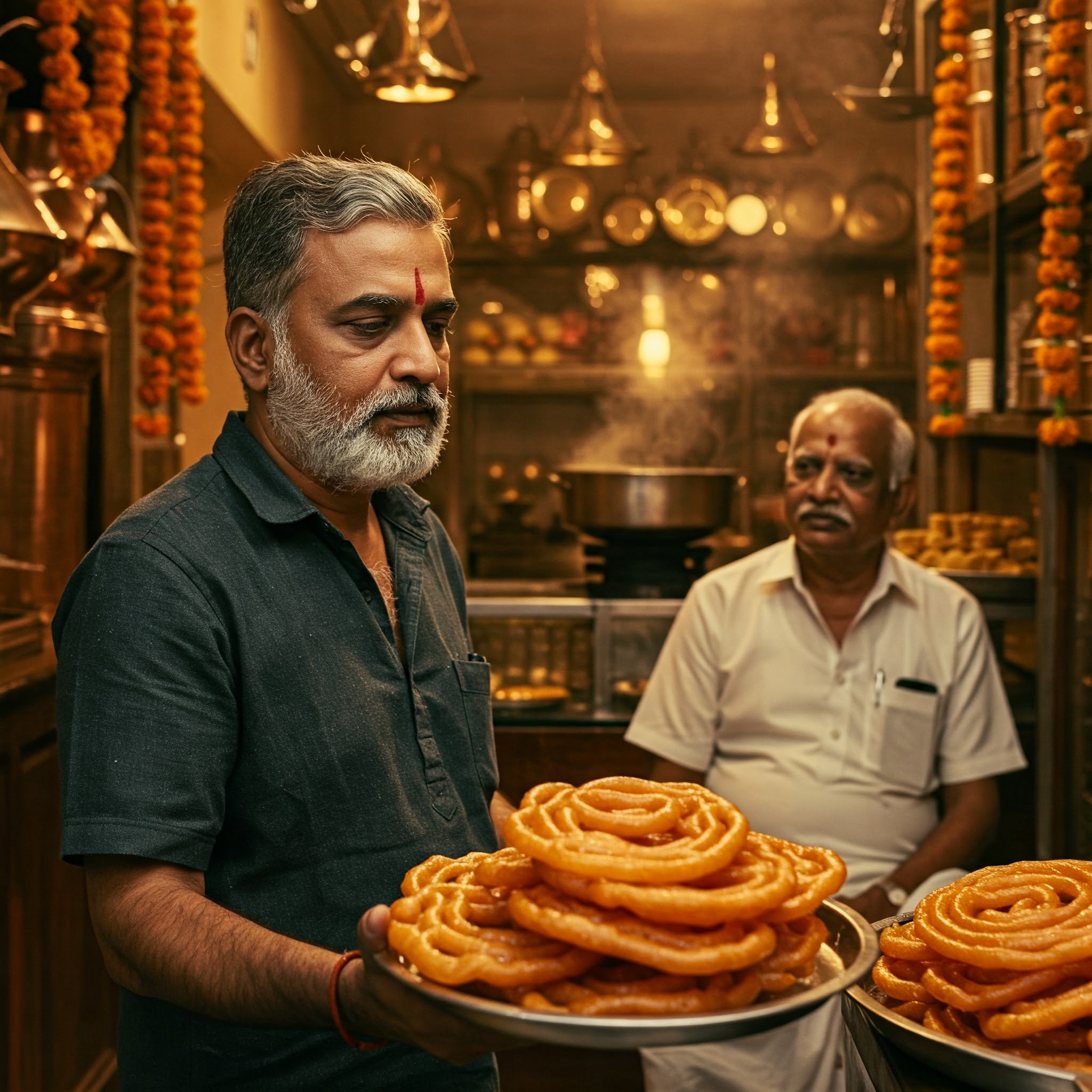
In the heart of our very own Telangana, in a small village much like ours, lived a halwai – a sweet maker – named Ramu. Now, Ramu’s jalebis… ah! They were legendary. Crispy on the outside, soaked in a syrup so fragrant with cardamom and saffron that just a whiff could make your mouth water. People would travel miles, crossing bumpy roads and dusty fields, just to taste Ramu’s jalebis. They were the color of a sunset, twisted into perfect little pretzels, and glistened with a sugary sheen that promised pure delight.
Ramu was a happy man. His shop was always bustling, filled with the chatter of eager customers and the sweet aroma of his creations. He had a loving wife, a mischievous son, and enough to keep them comfortable. But, like a tiny ant that gets lost in a mountain of sugar, Ramu started to crave more. More praise, more customers, more… well, just more.
One day, a wealthy Sethji – a merchant – visited Ramu’s shop. He tasted a jalebi, his eyes widened, and he declared, “Ramu, these are the finest jalebis I have ever tasted! I have a grand feast tomorrow for many important guests. Can you make a special batch, the most exquisite jalebis the world has ever seen?”
Ramu’s chest swelled with pride. “Sethji,” he said, puffing out his cheeks a little, “for you, I will create jalebis that will make the gods themselves envious!”
He spent the entire night grinding the finest wheat, using the purest ghee, and simmering the syrup with extra saffron and a secret ingredient – a drop of rosewater his grandmother had taught him about. He made jalebis larger and more intricate than ever before, each one a golden masterpiece. The aroma that wafted from his kitchen was intoxicating.
The next day, Sethji’s men came with large platters, and Ramu carefully arranged his special jalebis, his heart thrumming with anticipation. He imagined the praise, the awe, the even greater fame that would surely follow.
But, my dears, sometimes what looks the sweetest can hold the most bitterness.
As the day wore on, news started trickling back to the village. Sethji’s feast had been a disaster. His guests, important and influential people, had taken one bite of Ramu’s magnificent jalebis and… made faces. They were polite, of course, but the whispers soon started. “Too sweet,” some murmured. “Overpowering,” others complained. “It tastes… artificial,” a few even whispered amongst themselves.
Ramu was bewildered. How could this be? He had used the best ingredients, put in his heart and soul. He waited anxiously for Sethji to return, expecting anger, perhaps even a demand for his money back.
When Sethji finally came, his face was not angry, but strangely thoughtful. He sat down heavily on the small stool in Ramu’s shop and sighed. “Ramu,” he said, “your jalebis were… indeed special. Too special, perhaps.”
Ramu’s voice trembled. “But… but I used the finest…”
Sethji held up a hand. “You tried too hard, my friend. In your desire to make them the ‘most exquisite,’ you added too much of everything. The sweetness became cloying, the flavors fought with each other. It was no longer the simple, delightful jalebi that we all love.”
Ramu’s shoulders slumped. He looked at the few remaining jalebis on his counter, their golden sheen now seeming almost mocking. He had been so focused on making something grand, something more, that he had lost the simple perfection of what he already had.
The bitter truth, my little ones, was that Ramu’s greed for more praise had led him to ruin the very thing that had brought him joy and success in the first place. He had forgotten the balance, the simplicity that made his jalebis so beloved.
From that day on, Ramu went back to making his jalebis the way he always had. He still used the best ingredients and poured his heart into his work, but he remembered Sethji’s words. He learned that sometimes, the sweetest things in life are the simplest, and that chasing after more can often lead you to lose the goodness you already possess.
He continued to make his wonderful jalebis, and people continued to flock to his shop. But Ramu was a changed man. He was content with the love of his family, the appreciation of his customers, and the simple joy of creating something delicious. He had tasted the bitter truth hidden beneath the overly sweet jalebi, and it was a lesson he never forgot.
So, my darlings,” Dadi Sarala concluded, her gaze soft, “remember this story when you crave more than what you have. Sometimes, the greatest sweetness lies in appreciating the simple joys and the honest work of your own hands. Don’t let the desire for ‘more’ spoil the goodness that is already yours.” She then reached for the bowl of puffed rice and offered it to the children, a gentle smile gracing her lips. The simple, roasted grains tasted wonderfully satisfying in the quiet afternoon.
Leave a Reply