
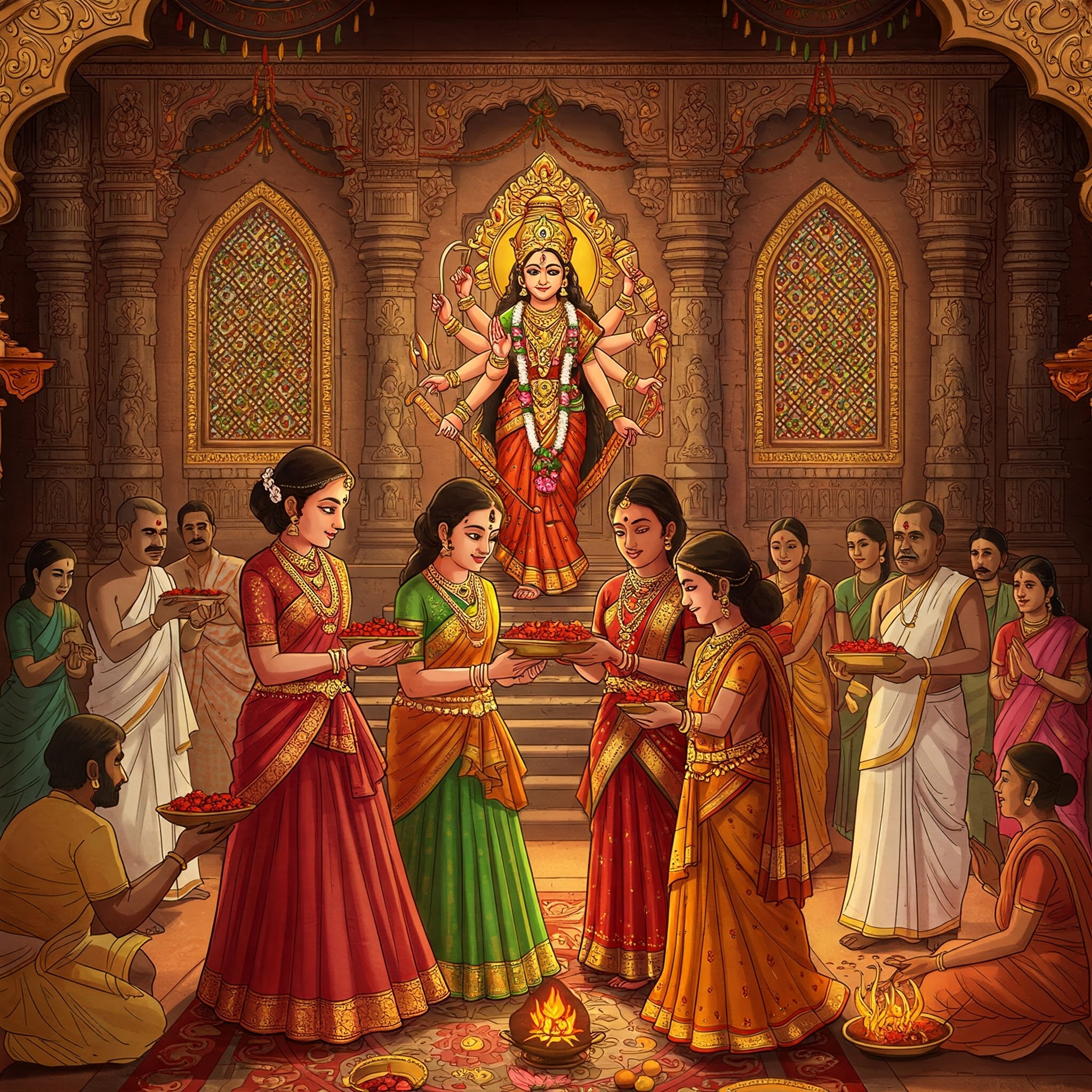
In the Chidambaram temple, where the goddess Durga is revered for her fierce power, Grandmother Anjali would tell her grandchildren the story of the Navaratri Festival, a nine-night celebration of the goddess’s triumph over evil.
“Navaratri, my dear ones,” she began, “is not just about feasts and celebrations. It’s about a journey of self-purification, a dedication to the goddess who protects the universe.”
“Why nine nights, Ammamma?” asked little Meera.
“Well,” Anjali smiled, “each night of Navaratri represents a different form of Durga—from Kali, the fierce destroyer of evil, to Lakshmi, the goddess of wealth, and Saraswati, the goddess of wisdom. On the last day, Goddess Durga defeats Mahishasura, the demon, and restores peace.”
She continued, “In Chidambaram, the rituals are special. On the first day, young girls, who are seen as manifestations of Durga, are honored in a ritual called Kumari Puja. Families invite young girls, dress them in fine clothes, and offer them food and gifts, just as the goddess was adored by her devotees.”
Anjali looked at Meera thoughtfully, “This Kumari Puja signifies the purity and power of the goddess that lives in every child—every young girl represents the strength of Durga, and we must honor and protect that power.”“And at night,” Grandma added, “there are devotional dances, the Garba, and the Dandiya. People circle around the temple in rhythmic steps, paying homage to the goddess, while the atmosphere is filled with sacred chants. The goddess is invited into every home.”
Leave a Reply