
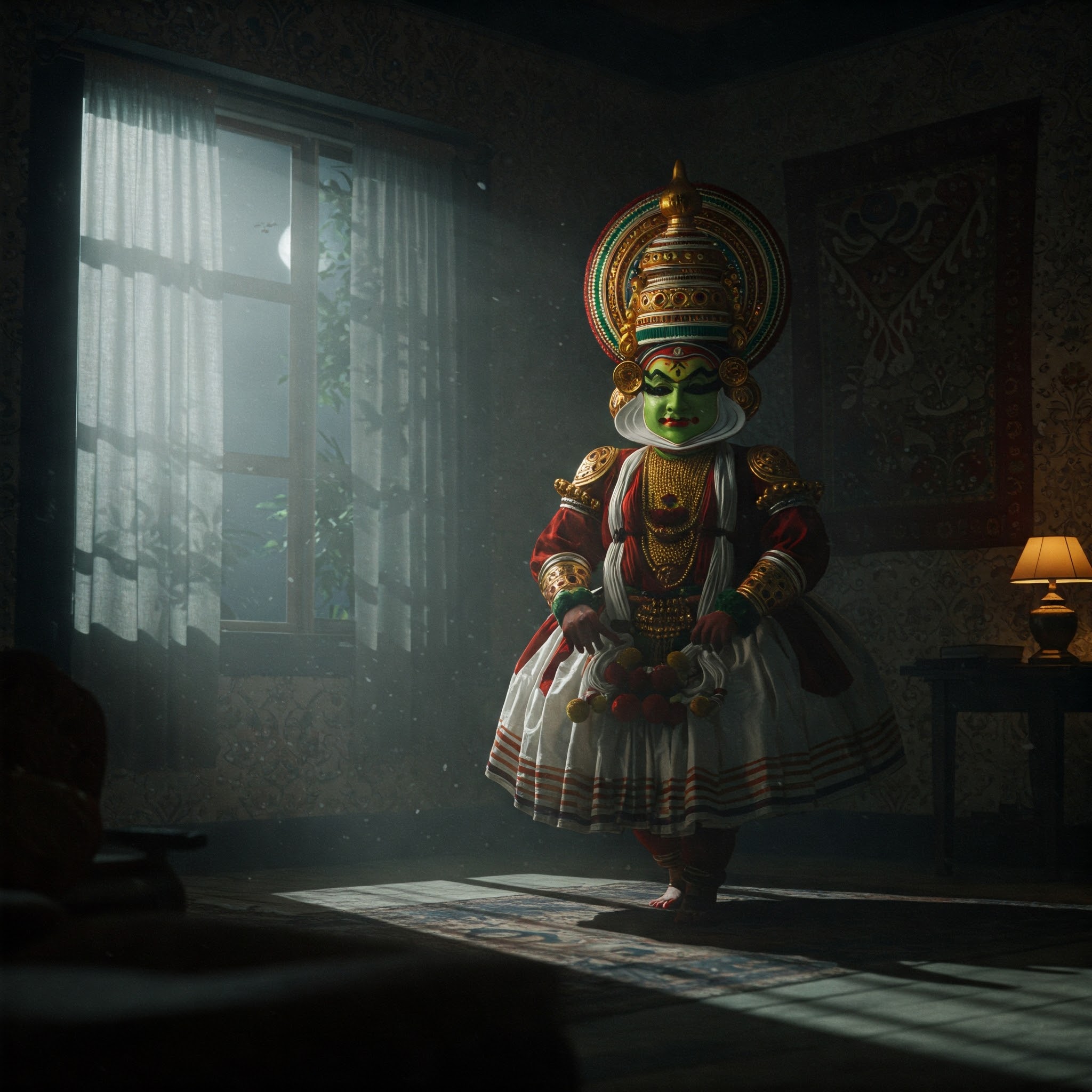
(As told by Ammamma Janaki, while the children sat cross-legged on the cool, coconut-mat floor of their home in Kuttanad, the gentle lapping of the backwaters against the stilts providing a soothing rhythm, and the air thick with the scent of frying banana chips)
“Come, my little water lilies,” Ammamma Janaki began, her voice as melodious as the songs of the boatmen on the Vembanad Lake. She carefully adjusted the gold chain around her neck and her eyes, reflecting the dappled sunlight filtering through the palm fronds, held a spark of playful mystery. “Tonight, I will tell you about a boy named Appu, and a Kathakali mask that loved to dance… all on its own.”
In our very own Kuttanad, where the backwaters weave through the land like silver ribbons and the air hums with the calls of water birds, lived a young boy named Appu. Appu loved everything about his village – the swaying coconut palms, the chugging of the houseboats, the taste of freshly caught karimeen, and most of all, the vibrant art of Kathakali.
Kathakali, as you know, is a magnificent dance-drama where performers, adorned in elaborate costumes and striking makeup, tell ancient stories through intricate movements and expressive gestures. Appu would spend hours watching the rehearsals in the village temple courtyard, his eyes wide with fascination at the larger-than-life characters that came alive before him.
One day, a traveling Kathakali troupe came to their village to perform a story about a fierce Rakshasa warrior. The most captivating part of the performance for Appu was the enormous, intricately carved mask worn by the actor playing the Rakshasa. It had bulging eyes, sharp teeth, and a fearsome expression that both thrilled and slightly scared him.
After the performance, the troupe packed up their belongings, but in their haste, they accidentally left one mask behind – the very Rakshasa mask that had so mesmerized Appu. Appu found it lying beneath a banyan tree, its painted face staring up at the sky.
He carefully picked it up. It was surprisingly light, made of wood and painted in vibrant shades of red, black, and white. He ran home, his heart pounding with excitement. He couldn’t wait to show Thatha and Amma his incredible find.
They were impressed by the mask’s artistry but told Appu to return it to the troupe if they came back looking for it. However, days turned into weeks, and the troupe didn’t reappear. Appu kept the mask, carefully storing it in a wooden chest in his room.
One particularly still night, when the only sound was the gentle croaking of frogs in the backwaters, Appu was fast asleep. Suddenly, he was awakened by a soft tapping sound. He sat up in bed, his heart thumping. The tapping came again, this time a little louder.
He cautiously looked around his room. The moonlight streaming through the window cast long, eerie shadows. And then he saw it. The wooden chest where he kept the Rakshasa mask was slightly open, and the tapping sound seemed to be coming from inside.
Slowly, Appu crept towards the chest and peered inside. In the dim moonlight, he saw the Kathakali mask… moving! It was tilting its head, and its painted eyes seemed to be looking around the room. The tapping sound was the back of the mask gently hitting the inside of the chest.
Appu was terrified but also incredibly curious. He slowly reached out and lifted the mask. As soon as his fingers touched it, the mask became still. He held his breath, waiting. Then, as he relaxed his grip slightly, the mask began to move again, its head swaying gently as if it were listening to some unheard music.
Over the next few nights, Appu discovered the secret of the mask. It seemed to come alive on its own, especially when there was no loud noise around. It would sway, nod, and even make soft tapping sounds, almost as if it were dancing silently in the moonlight.
Appu, initially scared, grew accustomed to the mask’s strange behavior. He would often take it out of the chest and watch it move, mesmerized by its silent dance. He wondered if the spirit of the Rakshasa actor had somehow remained within the mask.
One evening, as Appu was watching the mask sway gently, he started to hum a Kathakali tune he had heard the troupe play. As he hummed, the mask’s movements became more pronounced, its head tilting and turning in time with the music. It was as if the mask was truly dancing to his song!
Appu realized then that the mask wasn’t haunted or magical in a scary way. It simply seemed to have a love for the art of Kathakali, a silent yearning to dance to the rhythms of the ancient stories.
The next time a boat carrying Kathakali performers passed through their village, Appu, clutching the Rakshasa mask, ran to the canal bank. He waved frantically, calling out to them. The performers, recognizing the missing mask, were overjoyed to see it again.
Appu explained how he had found it and the strange way it seemed to come alive at night. The lead performer, a wise old man with kind eyes, smiled knowingly. “Ah, young one,” he said, “this mask has played many powerful roles. Perhaps a little bit of the dance has stayed within it.”
They thanked Appu profusely and even invited him to watch their next performance up close. As the boat floated away, Appu felt a sense of satisfaction. The dancing mask had found its way back to its art.
Ammamma Janaki chuckled, the sound like the gentle ripple of the backwaters. “So, my little water lilies,” she said, her eyes twinkling with amusement, “remember Appu and the dancing Kathakali mask. Sometimes, even inanimate objects can hold a little bit of magic, a silent longing for the purpose they were created for. And sometimes, it takes a curious and kind heart to help them find their way back to their own unique dance.” The children, their imaginations filled with the image of a Rakshasa mask swaying silently in the moonlight, listened to the gentle lapping of the backwaters, perhaps imagining the hidden dances all around them.
Leave a Reply