
(As told by Nani Zooni, while the children sat huddled around her on a hand-woven Kashmiri rug in their home in Pampore, the air fragrant with the delicate scent of drying saffron threads, and the distant sounds of a Rabab playing a melancholic tune drifted through the window)
“Come closer, my little saffron buds,” Nani Zooni began, her voice as soft and warm as the Kashmiri sun on a spring morning. She gently ran her fingers over the intricate embroidery of her pheran and her eyes, the color of a clear mountain sky, held a touch of wistful remembrance. “Tonight, I will tell you about the saffron fields of Kashmir, and a song that was once lost, just like a single precious strand in a vast harvest.”
In the valley of Kashmir, where the snow-capped Himalayas stand as silent sentinels and the air is crisp and clean, lies the beautiful region of Pampore, famous for its sprawling saffron fields. These fields, for a few weeks each autumn, transform into a breathtaking tapestry of purple blooms, their delicate stigmas holding the world’s most precious spice.
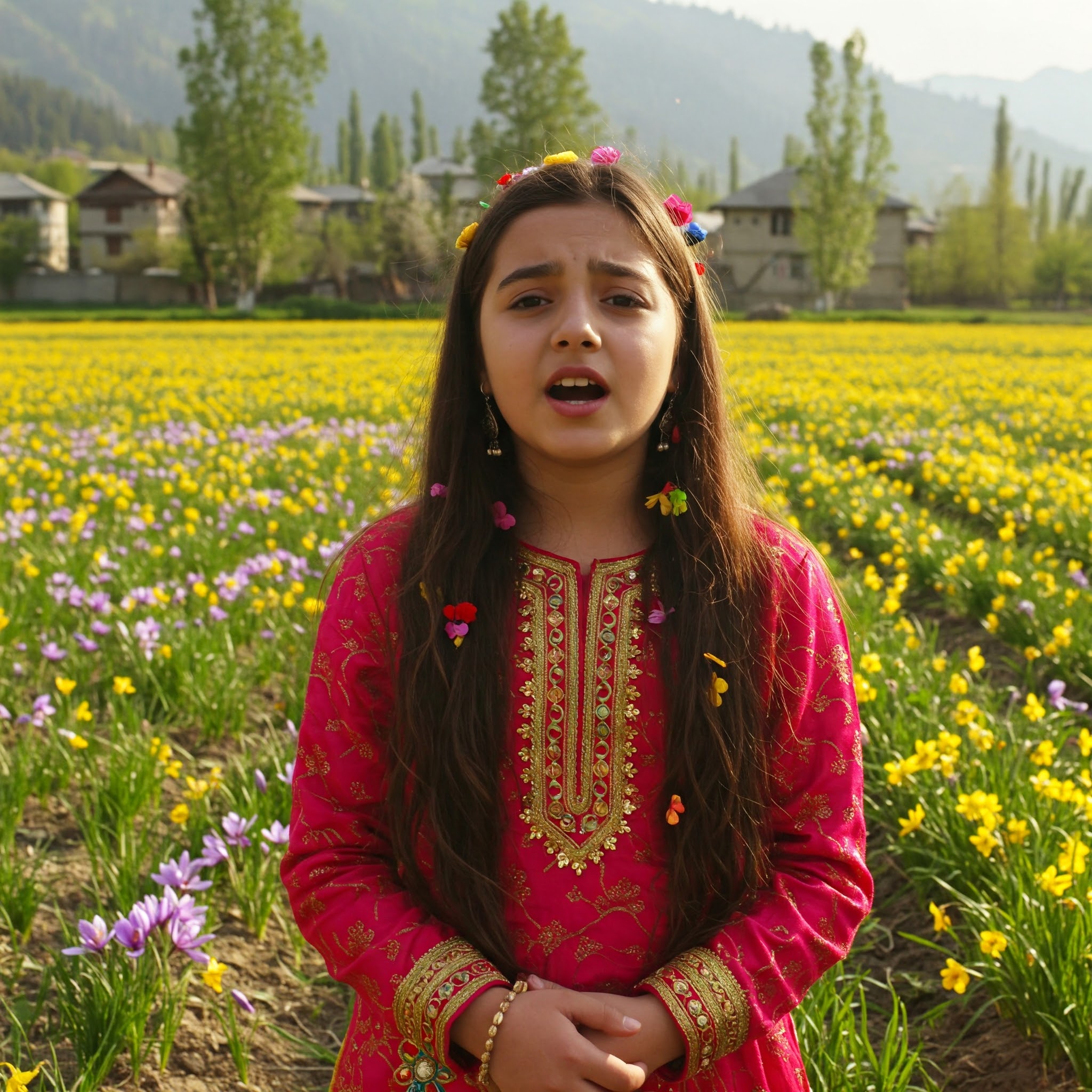
In a small village nestled amidst these fragrant fields lived a young girl named Roohi. Roohi’s family had cultivated saffron for generations. She grew up with the sweet, earthy aroma of the blossoms filling her senses, and her small hands were adept at carefully plucking the delicate red threads.
Roohi had a voice as sweet as the first taste of saffron-infused kehwa. Her grandmother, Badi Jaan, a woman whose wisdom was as deep as the Jhelum River, had taught her an ancient folk song, a melody passed down through their family for generations. This song was said to capture the very essence of the saffron fields – the beauty of the blooms, the hard work of the harvest, and the golden promise held within each tiny strand.
Roohi would sing this song as she worked in the fields, her voice blending with the buzzing of bees and the gentle whisper of the wind. The other saffron pickers would often pause their work to listen, their hearts filled with a sense of connection to the land and their heritage.
But one autumn, as the saffron bloomed in its full glory, a sadness fell upon Roohi’s family. Badi Jaan, the keeper of the song, fell ill. As her strength faded, so did her voice, and the ancient saffron song remained unsung in the fields.
Roohi was heartbroken. She loved the song, not just for its beautiful melody, but because it reminded her of Badi Jaan and the deep roots of her family in the saffron fields. She tried to remember the tune, the words, but they seemed to have slipped away like the morning mist.
The saffron harvest began, but the fields felt strangely quiet without Badi Jaan’s song. The other pickers worked in silence, their movements lacking the usual rhythm and joy. Roohi walked through the purple blooms, a heavy feeling in her chest, the lost song echoing in the silence of her memory.
One day, as she sat by Badi Jaan’s bedside, holding her frail hand, Roohi noticed her grandmother’s fingers gently tapping a familiar rhythm on the blanket. It was the rhythm of the saffron song!
Roohi’s heart leaped with hope. She leaned closer, humming the few fragmented notes she could recall. Badi Jaan’s eyes fluttered open, and a faint smile touched her lips. Slowly, weakly, she began to hum along, her voice a mere whisper, but the melody was there.
Together, Roohi and Badi Jaan, the young voice and the old, pieced together the lost song, note by precious note, word by remembered word. It was a slow and tender process, filled with love and a deep connection to their heritage.
Finally, on the last day of the saffron harvest, as the sun cast a golden glow over the purple fields, Roohi stood amidst the blooms and began to sing. Her voice, clear and strong, carried the ancient melody across the valley.
The other saffron pickers stopped their work and listened, their faces filled with emotion. It was the song they had missed, the song that spoke of their land, their work, and their history. As Roohi sang, a sense of joy and unity filled the air, as fragrant and precious as the saffron threads they harvested.
Badi Jaan, who had been brought to the edge of the fields in a shawl, listened with tears in her eyes, a proud smile on her face. The lost song had been found, carried on the voice of a young girl who cherished her heritage.
Nani Zooni sighed contentedly, the scent of saffron around them seeming to intensify. “So, my little saffron buds,” she said softly, her gaze distant, “remember Roohi and the lost song. Our traditions, our stories, and our songs are like the precious strands of saffron – they connect us to our past and enrich our present. Even when they seem lost, with love, patience, and a deep connection to our roots, they can always be found again, their beauty and fragrance even more cherished for having been rediscovered.” The children, their imaginations filled with the image of purple fields echoing with an ancient melody, listened to the melancholic strains of the distant Rabab, understanding the enduring power of memory and heritage.
Leave a Reply